What do I need to know about substance use prevention before I get started?
Primary Prevention
Before you get started, California counties receiving SUBG primary prevention set-aside funding must adhere to state and federal requirements (45 CFR 96.121) to use funding directed at individuals who have not been determined to require treatment for a substance use disorder.
To assist counties in implementing comprehensive primary prevention strategies, SUPER includes information on the six prevention strategies, target populations, environmental prevention, risk and protective factors, and the Institute of Medicine Continuum of Care Model.
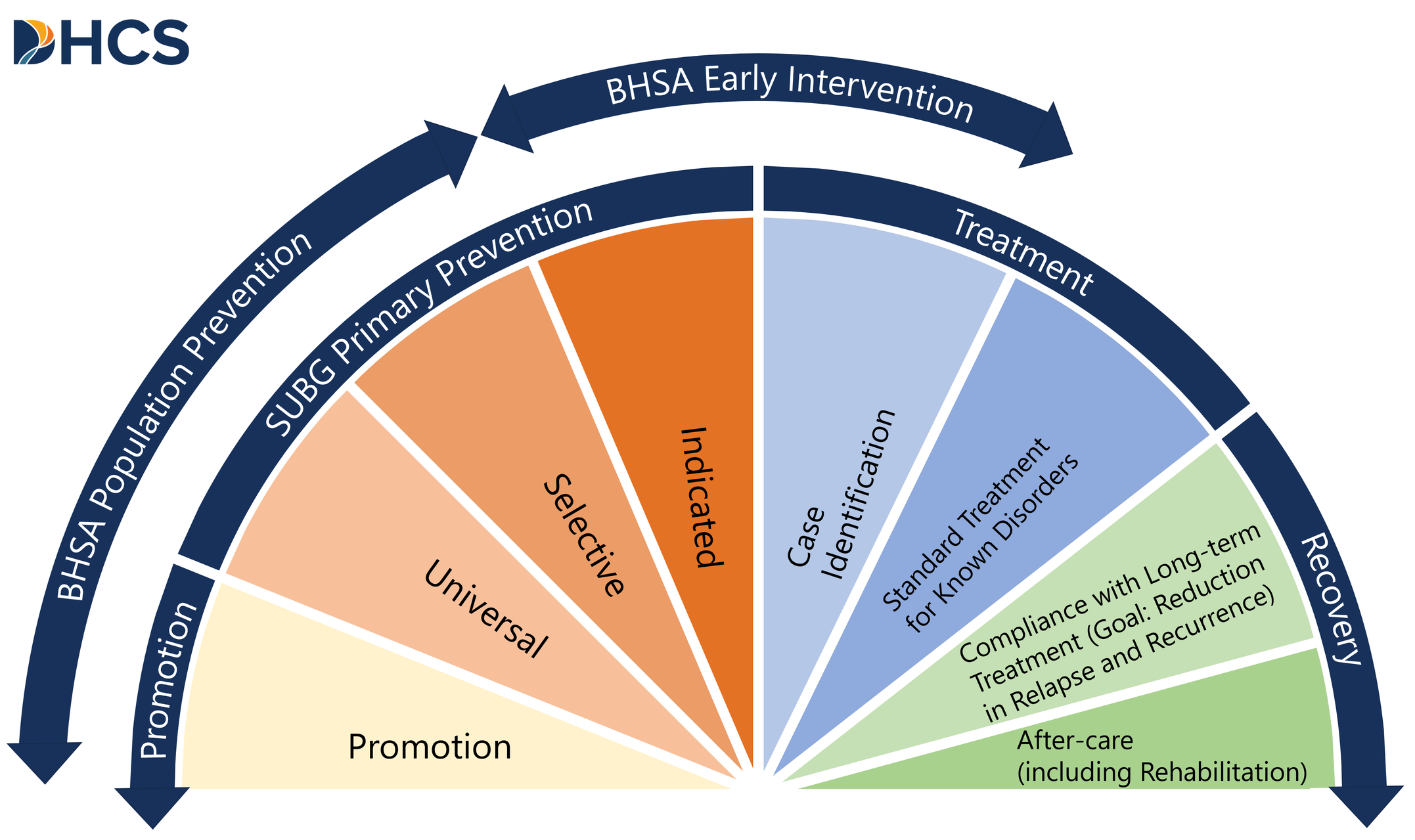
The Department of Health Care Services (DHCS) uses the Institute of Medicine Continuum of Care model to define three categories of prevention services: Universal, Selective, and Indicated.
DHCS-approved Institute of Medicine Continuum of Care prevention spectrum (funder spec p.17).
Adapted from the Institute of Medicine Continuum of Care Model. BHSA — Behavioral Health Services Act SUBG — Substance Use Prevention, Treatment, and Recovery Block Grant
Universal Prevention
Universal prevention is prevention services/activities for the general public or a whole population group that has not been identified on the basis of individual risk. Universal prevention includes strategies that can be offered to the full population, based on the evidence that it is likely to provide some benefit to all (reduce the probability of disorder), which clearly outweighs the costs and risks of negative consequences. There are two main types of universal prevention:
Universal Direct Prevention: Service recipients are present and are not receiving primary prevention services based on individual risk, also referred to as individual-based programs/services. Examples of universal direct programs include school prevention curricula, after-school programs, and parenting classes.
Universal Indirect Prevention: Service recipients are not present, and services support capacity-building and awareness for the entire population, also referred to as population-based programs/services. Examples of universal indirect programs include establishing alcohol, tobacco, and other drug policies and modifying advertising practices.
Selective Prevention
Selective prevention is prevention services/activities for individuals or a subgroup of the population whose risk of developing substance use disorders are significantly higher than average. The risk may be imminent or it may be a lifetime risk.
Risk groups may be identified on the basis of biological, psychological, or social risk factors that are known to be associated with the onset of a disorder. Those risk factors may be at the individual level for non-behavioral characteristics (e.g., biological characteristics such as low birth weight), at the family level (e.g., children with a family history of substance abuse but who do not have any history of use), or at the community/population level (e.g., schools or neighborhoods in high poverty areas).
Selective prevention refers to strategies for subpopulations identified as being at an elevated risk for developing a substance use disorder.
Examples of selective prevention include programs for children of parents with substance use disorders and programs for families who live in high-crime or low-income neighborhoods.
Indicated Prevention
Indicated prevention is prevention services/activities for high-risk individuals who are identified as having minimal but detectable signs or symptoms that foreshadow a substance use disorder, as well as biological markers that indicate a predisposition in a person for such a disorder but who does not meet diagnostic criteria at the time of the intervention.
Indicated prevention includes services for individuals who are identified (or individually screened) as having an increased vulnerability for a substance use disorder based on some individual assessment but who are currently asymptomatic.
Examples of indicated prevention include driving under the influence education programs and programs for youth who face disciplinary issues related to substance use at school.
Socio-Ecological Model for Prevention
Substance use disorder prevention can occur at multiple levels. The Substance Abuse and Mental Health Services Administration (SAMHSA) Socio-Ecological Model describes how there are four levels—the individual, relationship, community, and society—that influence each other and may impact youth substance use behavior.
Society
Community
Relationship
Individual
Individual Level
Individual-Level factors include age, education, income, health, and psychosocial problems that may correspond with substance use.
For example, youth who exhibit poor self-regulation, impaired control, and impulsiveness are more likely to engage in binge alcohol use.
Relationship Level
Relationship-Level factors include close social circles—family members, peers, teachers, and other close relationships—that contribute to youth's range of experience and may influence their behavior.
For example, youth who spend time with peers who believe cannabis use is beneficial and not harmful are more likely to use cannabis.
Community Level
Community-Level factors include the settings in which social relationships occur, such as schools, workplaces, and neighborhoods.
For example, living in neighborhoods with chronically high rates of disorganization, crime, and unemployment is associated with higher risk for substance use.
Society Level
Society-Level factors include social and cultural norms, social drivers of health, and educational and social policies that contribute to economic and/or social inequalities or lack of opportunities.
For example, social and cultural norms that portray substance use as commonplace or as a rite of passage are associated with higher rates of youth substance use.
This strategy provides awareness and knowledge of the nature and extent of alcohol, tobacco and drug use, abuse and addiction and their effects on individuals, families, and communities. It also provides knowledge and awareness of available prevention programs and services. Information dissemination is characterized by one-way communication from the source to the audience, with limited contact between the two.
Examples of information dissemination include media campaigns, community and school outreach events, and the development of printed materials or websites.
2. Education
This strategy involves two-way communication and is distinguished from the Information Dissemination strategy by the fact that interaction between the educator/facilitator and the participants is the basis of its activities. Activities under this strategy aim to affect critical life and social skills, including decision-making, refusal skills, critical analysis (e.g. of media messages) and systematic judgment abilities.
Examples of educational activities include group sessions for youth, community/school educational services, and mentoring.
3. Alternatives
This strategy provides for the participation of target populations in activities that exclude alcohol, tobacco, and other drug use. The assumption is that constructive and healthy activities offset the attraction to, or otherwise meet the needs usually filled by alcohol, tobacco and other drugs and would, therefore, minimize or obviate resort to the latter.
Examples of alternatives include community service activities, social/recreational activities, and youth-adult leadership activities.
4. Problem Identification and Referral
This strategy aims at identification of those who have indulged in illegal/age-inappropriate use of tobacco or alcohol and those individuals who have indulged in the first use of illicit drugs to assess if their behavior can be reversed through education. It should be noted, however, that this strategy does not include any activity designed to determine if a person needs treatment.
Examples of problem identification and referral include student assistance programs, driving while under the influence/driving while intoxicated education programs, and brief interventions.
5. Community-Based Process
This strategy aims to enhance the ability of the community to provide prevention and treatment services more effectively for alcohol, tobacco, and drug abuse disorders. Activities in this strategy include organizing, planning, enhancing efficiency and effectiveness of services implementation, inter-agency collaboration, coalition building and networking.
Examples of community-based process include coalition and workgroup activities, community and volunteer training, and system planning.
6. Environmental
This strategy establishes or changes written and unwritten community standards, codes and attitudes, thereby influencing incidence and prevalence of the abuse of alcohol, tobacco, and other drugs used in the general population. This strategy is divided into two subcategories to permit distinction between activities which center on legal and regulatory initiatives and those which relate to the service and action-oriented initiatives.
Examples of environmental prevention include promotion and enforcement of effective alcohol, drug, and tobacco use policies, modification of advertising practices, and product pricing strategies.
Risk and Protective Factors
The Substance Abuse and Mental Health Services Administration defines substance use risk and protective factors as conditions in people's lives that make them more or less likely to use alcohol, tobacco, or illicit drugs.
Effective youth substance use prevention reduces risk factors while boosting protective factors. In addition, since many risk and protective factors related to substance use are related to mental health, several mental health risk and protective factors can also impact substance use behaviors.
See the tables below for an overview of key substance use and mental health risk and protective factors that are often the focus of prevention efforts, as well as the shared risk and protection factors that impact both substance use and mental health.
Youth Substance Use Risk and Protective Factors
Level
Risk Factors
Protective Factors
Individual
Conduct Disorder
Early and persistent antisocial behavior
Early initiation of substance use
Favorable attitudes towards substance use
Internalizing behaviors (e.g. anxiety, depression, social withdrawal)
Negative emotional state
Poor coping skills and behaviors
Rebelliousness
Ability to adapt to change and the belief in one's ability to control what happens
Emotional self-regulation
High self-esteem
Personal engagement in two or more of the following: school, peers, athletics, employment, religion/spirituality, culture
Positive social orientation (e.g. engaging in healthy activities, accepting rules and community values, positive social engagement)
Positive temperament
Strong coping skills (e.g., problem-solving skills, ability to stand up for beliefs and values)
Family and Relationships
Family conflict
Family experiences of poverty
Family management problems
History of family substance misuse
Lack of adult supervision
Poor attachment with caregivers
Substance use among caregivers
Attachment between caregivers and youth, including unity, warmth, and attachment
Clear expectations for behaviors and values
Communication and contact between caregivers and youth
Family environment with structure, rules, predictability, and parental supervision
Supportive relationships with family
School, Peer, and Community
Academic failure
Accessibility or availability of substances
Lack of Friendships/Peer rejection
Lack of plans or ambitions for the future
Low commitment to school
Norms favorable towards substance use
Peer aggression or violence
Substance use among peers
Community norms, beliefs, and standards against substance use
Opportunities for prosocial engagement in the school and community
Opportunities for the development of skills and interests
Physical and psychological safety
Positive peer relationships
Positive social norms
Presence of mentors and healthy adults for positive emotional support
Schools and student bodies with strong academic commitment
Shared Substance Use and Mental Health Risk and Protective Factors
Level
Risk Factors
Protective Factors
Individual
Negative emotional state
Poor coping skills and behaviors
Emotional self-regulation
High self-esteem
Personal engagement in two or more of the following: school, peers, athletics, employment, religion/spirituality, culture
Strong coping skills (e.g., problem-solving skills, ability to stand up for beliefs and values)
Family and Relationships
Family conflict
Family experiences of poverty
Family management problems
Substance use among caregivers
Attachment between caregivers and youth, including unity, warmth, and attachment
Clear expectations for behaviors and values
Communication and contact between caregivers and youth
Family environment with structure, rules, predictability, and parental supervision
Supportive relationships with family
School, Peer, and Community
Academic failure
Low commitment to school
Norms favorable towards substance use
Substance use among peers
Opportunities for prosocial engagement in the school and community
Physical and psychological safety
Positive social norms
Presence of mentors and healthy adults for positive emotional support
Effective substance use prevention blends diverse practice components such as skills training, educational interventions, community engagement, and policy development. These elements are vital for driving meaningful change at individual, relationship, community, and societal levels.
The tables below outline common components found in effective substance use prevention practices.
Individual-Level Practice Components — Substance Use Disorder Primary Prevention
Practice Component
Description
Alcohol/Drug Education
Teach youth about substance use and substance use-related issues. Specific knowledge and/or education about the use or effects of alcohol/drugs on development and lifestyle, and beliefs/perceptions about alcohol/drugs.1
Anger Management
Exercises or techniques designed to promote youth's ability to regulate or prevent anger or aggressive expression and seek productive resolutions to problems.2
Assertiveness Training
Exercises are designed to promote youth's ability to assert needs appropriately with others.2
Behavioral Modification
Interventions that utilize principles of rewards, punishment, and/or reinforcement to facilitate behavior change.3
Civic Responsibility
Teaching youth civic engagement, respect for people and property, advocacy and volunteerism.2
Cognitive Behavioral Strategies
Services that help youth alter their interpretation of thoughts, recognize situations in which they are most likely to use substances, and/or how to avoid and appropriately cope with those situations. Techniques designed to alter interpretation of events through examination of youth's reported thoughts.2
Communication Skills Training
Training on how to communicate more effectively with others.2
Cultural/Religious Focus
Interventions that utilize or leverage culture and/or religion in prevention programming.4
Goal Setting
Explicit selection of a life goal for youth to work towards.2
Insight Building
Activities are specifically designed to help a youth achieve greater self-understanding.2
Motivational Enhancement
Discussions that utilize reflective listening, open-ended strategies, and comparisons of behavior or feelings to normative standards.3
Problem Solving
Training in the use of techniques, discussions, or activities designed to bring about solutions to targeted problems.2
Psychoeducation
Discussion focused on handling day-to-day life issues that may directly or indirectly impact substance use. Promoting behavior change by providing education and information intended to promote healthy behavior decision-making.5
Relaxation
Techniques or exercises designed to induce psychological calming.2
Self-Efficacy/Self-Esteem Enhancement
Techniques to enhance self-confidence and improve self-efficacy.2
Self-Monitoring
Repeated measurement of a target index by youth. Observation and regulation of mood and behavior.1
Skills Training
Help youth develop skills to avoid or delay substance use (e.g. self-control), as well as information, training, and feedback to improve interpersonal communication. An interactive approach that helps youth develop social, emotional, and behavioral competencies that enable them to navigate high-risk situations effectively.1,3
Relationship-Level Practice Components — Substance Use Disorder Primary Prevention
Practice Component
Description
Parenting Education/Skills
Services that enhance parent supportiveness, communication, involvement in youths' lives, monitoring, and supervision, including substance use disorder prevention education and practice developing and enforcing family policies on substance use.1
Peer Norm Development
Establishment of peer norms that oppose the use of alcohol and drugs and promote positive behaviors and attitudes.2
Peer-Led Approaches
Have youth design and lead substance use prevention activities.3
Pro-Social Connections and Activities
Engagement in fun and positive activities without using substances to foster pro-social relationships.4
Support Networking
Identification of a group of people who can provide emotional and practical help to manage difficult situations.5
Community/Society-Level Practice Components — Substance Use Disorder Primary Prevention
Practice Component
Description
Community-Based Processes
Coalition-building, collaborative problem solving, and community development to facilitate substance use prevention promotion for youth.1
Economic Availability Reduction
Increase prices for alcohol, tobacco, and other substances.2
Enforce Existing Regulations
Initiatives that focus on enforcing existing laws, policies, and regulations that are designed to prevent youth substance use.2
Media Campaigns
General media and public awareness activities to inform the general population about the health risks associated with substance use.2
Promotion/Media Restrictions
Limiting, mitigating, or counteracting advertisements, discounts and/or sponsorships that promote alcohol, tobacco, and other substance use.2
Retail Availability Reduction
Reduce youth access to alcohol, tobacco, and other substances in locations such as stores, restaurants/bars, and online marketplaces.2
Shifting Community Norms
Make changes to general attitudes concerning the acceptability of substance use and behaviors.2
Social Availability Reduction
Strategies to prevent youth from procuring alcohol, tobacco, and other substances through sources outside of retail markets, such as family, friends, and other acquaintances.2
References
Individual-Level — SUD Primary Prevention
Skeen, S., Laurenzi, C. A., Gordon, S. L., Du Toit, S., Tomlinson, M., Dua, T., ... & Melendez-Torres, G. J. (2019). Adolescent mental health program components and behavior risk reduction: a meta-analysis. Pediatrics, 144(2), e20183488. doi:10.1542/peds.2018-3488
Boustani, M. M., Frazier, S. L., Becker, K. D., Bechor, M., Dinizulu, S. M., Hedemann, E. R., ... & Pasalich, D. S. (2015). Common elements of adolescent prevention programs: Minimizing burden while maximizing reach. Administration and Policy in Mental Health and Mental Health Services Research, 42(2), 209-219. doi:10.1007/s10488-014-0541-9
Tanner-Smith, E. E., Wilson, S. J., & Lipsey, M. W. (2013). The comparative effectiveness of outpatient treatment for adolescent substance abuse: A meta-analysis. Journal of Substance Abuse Treatment, 44(2), 145-158. doi:10.1016/j.jsat.2012.05.006
Substance Abuse and Mental Health Services Administration (2020). Focus on Prevention: Strategies and Programs to Prevent Substance Use. Rockville, MD: Center for Substance Abuse Prevention, Substance Abuse and Mental Health Services Administration.
Tanner-Smith, E. E., & Grant, S. P. (2019). Brief Interventions as Evidence-Based Prevention Strategies. In Z. Sloboda, H. Petras, E. Robertson, & R. Hingson (Eds). Prevention of Substance Use. Springer: Switzerland. doi:10.1007/978-3-030-00627-3
Relationship-Level — SUD Primary Prevention
Coatsworth, J. D., & George, M. W. (2019). Family Processes and Evidence-Based Prevention. In Z. Sloboda, H. Petras, E. Robertson, & R. Hingson (Eds). Prevention of Substance Use. Springer: Switzerland. doi:10.1007/978-3-030-00627-3
Birckmayer, J. D., Holder, H. D., Yacoubian Jr, G. S., & Friend, K. B. (2004). A general causal model to guide alcohol, tobacco, and illicit drug prevention: assessing the research evidence. Journal of Drug Education, 34(2), 121-153. doi:10.2190/PYL2-FF8N-6B6C-A57R
MacArthur, G. J., Harrison, S., Caldwell, D. M., Hickman, M., & Campbell, R. (2016). Peer-led interventions to prevent tobacco, alcohol and/or drug use among young people aged 11–21 years: a systematic review and meta-analysis. Addiction, 111(3), 391-407. doi:10.1111/add.13224
Substance Abuse and Mental Health Services Administration (2020). Focus on Prevention: Strategies and Programs to Prevent Substance Use. Rockville, MD: Center for Substance Abuse Prevention, Substance Abuse and Mental Health Services Administration.
Skeen, S., Laurenzi, C. A., Gordon, S. L., Du Toit, S., Tomlinson, M., Dua, T., ... & Melendez-Torres, G. J. (2019). Adolescent mental health program components and behavior risk reduction: a meta-analysis. Pediatrics, 144(2), e20183488. doi:10.1542/peds.2018-3488
Community/Society-Level — SUD Primary Prevention
Substance Abuse and Mental Health Services Administration (2020). Focus on Prevention: Strategies and Programs to Prevent Substance Use. Rockville, MD: Center for Substance Abuse Prevention, Substance Abuse and Mental Health Services Administration.
Birckmayer, J. D., Holder, H. D., Yacoubian Jr, G. S., & Friend, K. B. (2004). A general causal model to guide alcohol, tobacco, and illicit drug prevention: assessing the research evidence. Journal of Drug Education, 34(2), 121-153. doi:10.2190/PYL2-FF8N-6B6C-A57R