
Mental Health Wellness and Promotion
What do I need to know about mental health wellness and promotion before I get started?
Mental Health Wellness and Promotion Practices on SUPER
SUPER now features a list of mental health wellness and promotion practices to support counties, tribal entities, and community-based organizations in their behavioral health efforts. Incorporating mental health wellness practices on SUPER is beneficial, as many risk and protective factors for substance use also affect mental health.
By addressing these shared risk and protective factors, mental health wellness and promotion practices can also reduce the likelihood of substance use. In addition, youth who are effectively managing anxiety, depression, or other mental health challenges are less likely to turn to substances to cope with their symptoms. It may be beneficial to consider implementing both mental health wellness and promotion practices and traditional substance use prevention strategies.
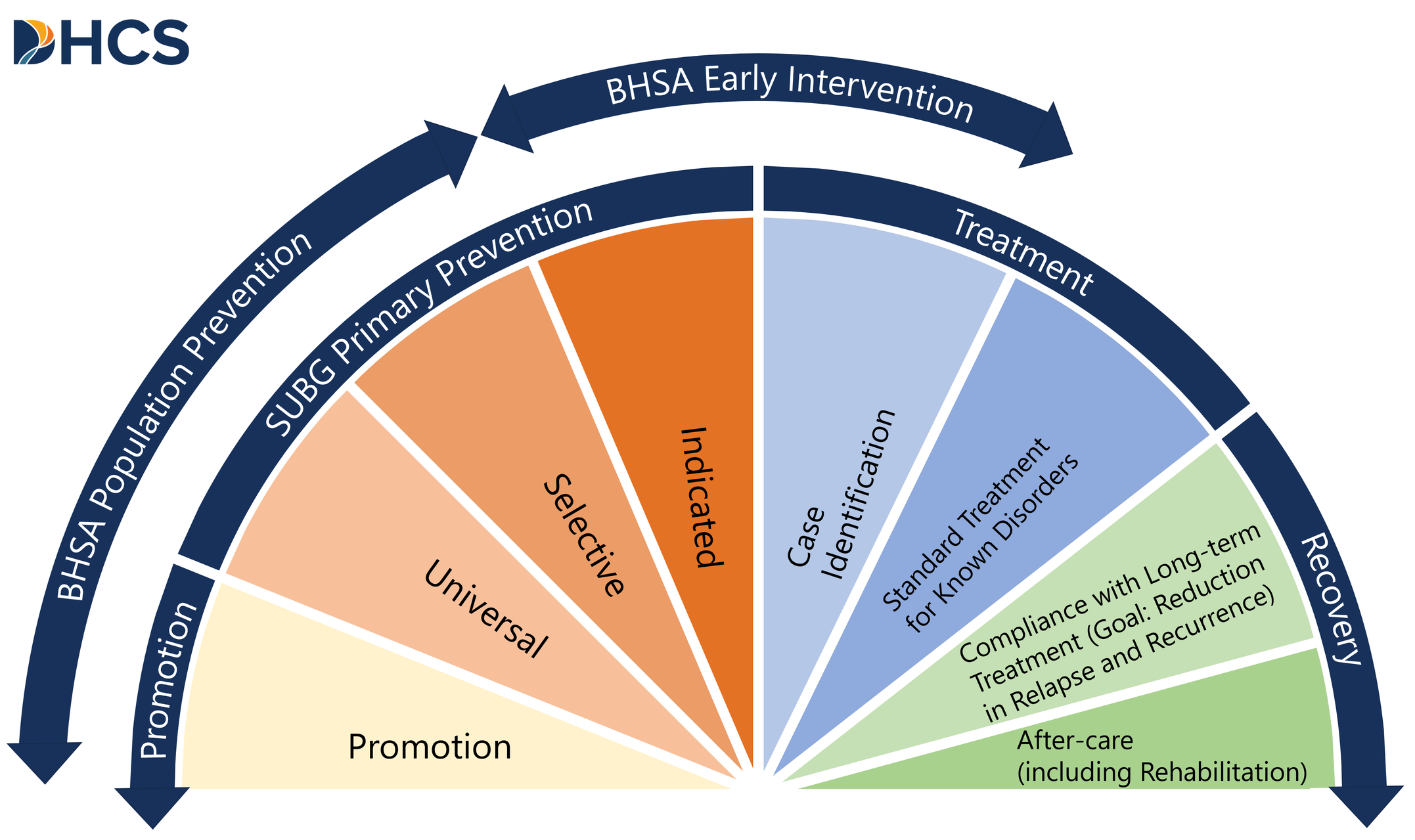
Adapted from the Institute of Medicine Continuum of Care Model. BHSA — Behavioral Health Services Act SUBG — Substance Use Prevention, Treatment, and Recovery Block Grant
Socio-Ecological Model for Mental Health Wellness and Promotion
Mental health wellness and promotion can occur at multiple levels. The Substance Abuse and Mental Health Services Administration (SAMHSA) Socio-Ecological Model describes how there are four levels—the individual, relationship, community, and society—that influence each other and may impact youth's mental well-being.
Individual Level
Individual-Level factors include age, education, income, health, and psychosocial problems that may correspond with mental health challenges.
For example, youth who experience persistent negative thoughts and have difficulty regulating their emotions are at higher risk for developing anxiety or depression.
Relationship Level
Relationship-Level factors include close social circles—family members, peers, teachers, and other close relationships—that contribute to youth's range of experience and may influence their behavior.
For example, youth who experience frequent family conflict or who lack supportive relationships at home are more likely to develop symptoms of depression or anxiety.
Community Level
Community-Level factors include the settings in which social relationships occur, such as schools, workplaces, and neighborhoods.
For example, youth attending schools where bullying is common or where mental health resources are limited experience higher rates of anxiety, depression, and suicidal ideation.
Society Level
Society-Level factors include social and cultural norms, social drivers of health, and educational and social policies that contribute to economic and/or social inequalities or lack of opportunities.
For example, social norms that stigmatize mental illness can prevent youth from seeking help, leaving symptoms untreated and worsening over time.
Risk and Protective Factors
Mental health risk and protective factors are conditions in people's lives that make them more or less likely to develop mental health problems. Effective mental health wellness and promotion services reduce risk factors while boosting protective factors. In addition, since many risk and protective factors related to substance use are related to mental health, several mental health risk and protective factors can also impact substance use behaviors.
See the tables below for an overview of key mental health risk and protective factors, as well as the shared risk and protective factors that impact both substance use and mental health.
Youth Mental Health Risk and Protective Factors
| Level | Risk Factors | Protective Factors |
|---|---|---|
| Individual |
|
|
| Family and Relationships |
|
|
| School, Peer, and Community |
|
|
Shared Substance Use and Mental Health Risk and Protective Factors
| Level | Risk Factors | Protective Factors |
|---|---|---|
| Individual |
|
|
| Family and Relationships |
|
|
| School, Peer, and Community |
|
|
References
Advance Behavioral Health Prevention California (2025). Understanding Risk and Protection: Contributing Factors for Adolescent Substance Use Disorders and Mental Health. Retrieved from https://abhpc.org/wp-content/uploads/2024/02/Understanding-Risk-and-Protection.pdf
Practice Components
Effective substance use prevention and mental health wellness and promotion blend diverse practice components such as skills training, educational interventions, community engagement, and policy development. These elements are vital for driving meaningful change at individual, relationship, community, and societal levels.
The tables below outline common components found in effective mental health wellness and promotion practices.
Individual-Level Practice Components — Mental Health Wellness and Promotion
| Practice Component | Description |
|---|---|
| Anger Management | Exercises or techniques designed to promote youth's ability to regulate or prevent anger or aggressive expression and seek productive resolutions to problems.1 |
| Assertiveness Training | Exercises designed to promote youth's ability to assert needs appropriately with others.1 |
| Behavioral Modification | Interventions that utilize principles of rewards, punishment, and/or reinforcement to facilitate behavior change.2 |
| Civic Responsibility | Teaching youth civic engagement, respect for people and property, advocacy and volunteerism.1 |
| Cognitive Behavioral Strategies | Services that help youth alter their interpretation of thoughts, recognize situations in which they are most likely to use substances, and/or how to avoid and appropriately cope with those situations. Techniques designed to alter interpretation of events through examination of youth's reported thoughts.1 |
| Communication Skills | Training in how to communicate more effectively with others.1 |
| Cultural/Religious Focus | Interventions that utilize or leverage culture and/or religion in prevention programming.2 |
| Goal Setting | Explicit selection of a life goal for youth to work towards.1 |
| Insight Building | Activities specifically designed to help youth achieve greater self-understanding.1 |
| Mental Health Education | Teaching youth about mental disorders, reducing stigma, and increasing awareness.4 |
| Motivational Enhancement | Discussions that utilize reflective listening, open-ended strategies, and comparisons of behavior or feelings to normative standards.5 |
| Problem Solving | Training in the use of techniques, discussions, or activities designed to bring about solutions to targeted problems.1 |
| Psychoeducation | Discussion focused on handling day-to-day life issues that may directly or indirectly impact substance use. Promoting behavior change by providing education and information intended to promote healthy behavior decision-making.6 |
| Relaxation | Techniques or exercises designed to induce psychological calming.1 |
| Self-Efficacy/Self-Esteem Enhancement | Techniques to enhance self-confidence and improve self-efficacy.1 |
| Self-Monitoring | Repeated measurement of a target index by youth. Observation and regulation of mood and behavior.4 |
| Skills Training | An interactive approach that helps youth develop social, emotional, and behavioral competencies that enable them to navigate high-risk situations effectively.1,4 |
Relationship-Level Practice Components — Mental Health Wellness and Promotion
| Practice Component | Description |
|---|---|
| Parenting Education/Skills | Services that enhance parent supportiveness, communication, involvement in youths' lives, monitoring, and supervision.1 |
| Support Networking | Strategies to explicitly identify, engage, develop, or otherwise increase the involvement or effectiveness of individuals in the youth's life. Identification of a group of people who can provide emotional and practical help to manage difficult situations.2 |
References
Individual-Level Practice Components
- Boustani, M. M., Frazier, S. L., Becker, K. D., Bechor, M., Dinizulu, S. M., Hedemann, E. R., ... & Pasalich, D. S. (2015). Common elements of adolescent prevention programs: Minimizing burden while maximizing reach. Administration and Policy in Mental Health and Mental Health Services Research, 42(2), 209-219. doi: 10.1007/s10488-014-0541-9
- Tanner-Smith, E. E., Wilson, S. J., & Lipsey, M. W. (2013). The comparative effectiveness of outpatient treatment for adolescent substance abuse: A meta-analysis. Journal of Substance Abuse Treatment, 44(2), 145-158. doi: 10.1016/j.jsat.2012.05.006
- Shernoff, E. S., Kratochwill, T. R., Ballard, S. C., Chen, S. M., & Boustani, M. M. (2025). Identifying common practice elements among consultation studies showing promising social and behavioral outcomes: A systematic review. Journal of School Psychology, 110, 101463. doi: 10.1016/j.jsp.2025.101463
- Skeen, S., Laurenzi, C. A., Gordon, S. L., Du Toit, S., Tomlinson, M., Dua, T., ... & Melendez-Torres, G. J. (2019). Adolescent mental health program components and behavior risk reduction: A meta-analysis. Pediatrics, 144(2), e20183488. doi: 10.1542/peds.2018-3488
- Tanner-Smith, E. E. & Grant, S. P. (2019). Brief Interventions as Evidence-Based Prevention Strategies. In Z. Sloboda, H. Petras, E. Robertson, & R. Hingson (Eds). Prevention of Substance Use. Springer: Switzerland. doi: 10.1007/978-3-030-00627-3
- Helland, S. S., Mellblom, A. V., Kjøbli, J., Wentzel-Larsen, T., Espenes, K., Engell, T., & Kirkøen, B. (2022). Elements in mental health interventions associated with effects on emotion regulation in adolescents: a meta-analysis. Administration and Policy in Mental Health and Mental Health Services Research, 49(6), 1004-1018. doi: 10.1007/s10488-022-01213-2
Relationship-Level Practice Components
- Helland, S. S., Mellblom, A. V., Kjøbli, J., Wentzel-Larsen, T., Espenes, K., Engell, T., & Kirkøen, B. (2022). Elements in mental health interventions associated with effects on emotion regulation in adolescents: A meta-analysis. Administration and Policy in Mental Health and Mental Health Services Research, 49(6), 1004-1018. doi: 10.1007/s10488-022-01213-2
- Skeen, S., Laurenzi, C. A., Gordon, S. L., Du Toit, S., Tomlinson, M., Dua, T., ... & Melendez-Torres, G. J. (2019). Adolescent mental health program components and behavior risk reduction: A meta-analysis. Pediatrics, 144(2), e20183488. doi: 10.1542/peds.2018-3488